
"How much does custom packaging cost?" is the first question every buyer asks, and any serious factory will answer it with a set of questions instead of a number — not to dodge, but because the number is produced by five levers that only move when the specification does. Learn the levers once and you can read any quotation, from any supplier, without taking the unit price on trust. This is the version we walk buyers through before they request a quote.
1. The five levers behind every quotation
Everything on a quotation exists to pay for one of five things. If a line does not trace back to one of these, ask what it is:
| Lever | What it pays for | How it moves the number |
|---|---|---|
| Board area | The rectangle of board the flat blank nests in, plus cutting waste | Geometry — recoverable with a ruler, not opinion |
| Quantity | Dieline, print plates, foil die, finishing masks — one-off work, identical at any volume | The steepest curve: setup spread over more pieces |
| Print colours | One plate and one press pass per colour | Grows with each colour added |
| Finishing | Each finish is its own pass; foil and spot UV add tooling | Stacks — three finishes are three setups, not one |
| Packing & freight | Cartons, protection, and the volume the shipment occupies | Often swings the comparison more than the box price |
The rest of this guide walks each lever in turn, with the arithmetic you can run on the dieline, the quotation or the packing list in front of you.
2. Board area: the box pays for the rectangle it nests in
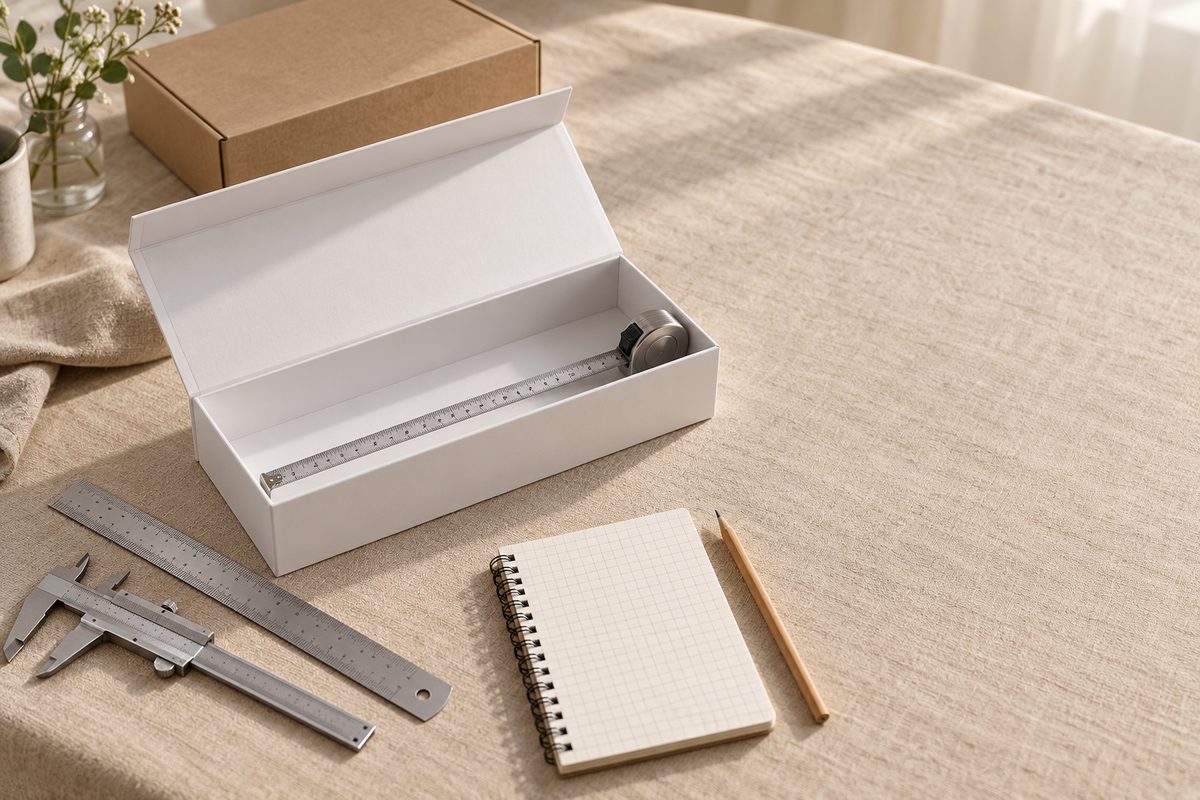
A folding carton is cut from one rectangle of board, and that rectangle is arithmetic you can check yourself. For a standard tuck-end carton, the blank is roughly two panel-widths plus the glue flap wide, and the height plus tuck flaps tall — so the board you pay for grows with the perimeter of the box, not its volume. A box that feels small at 100 × 60 × 40 mm still needs a blank more than twice that width, because the panels wrap around the tube.
Two consequences follow. First, going up one size step costs more than the size difference suggests, because added millimetres ride the perimeter twice (two side panels each) before they add anything to depth. Second, shapes that nest badly cost more at identical size: blanks are cut in batches from large sheets, and a long thin box or an angled flap leaves more offcut between neighbouring blanks than a compact rectangle does. Neither is a markup — it is wasted board, and you are buying it.
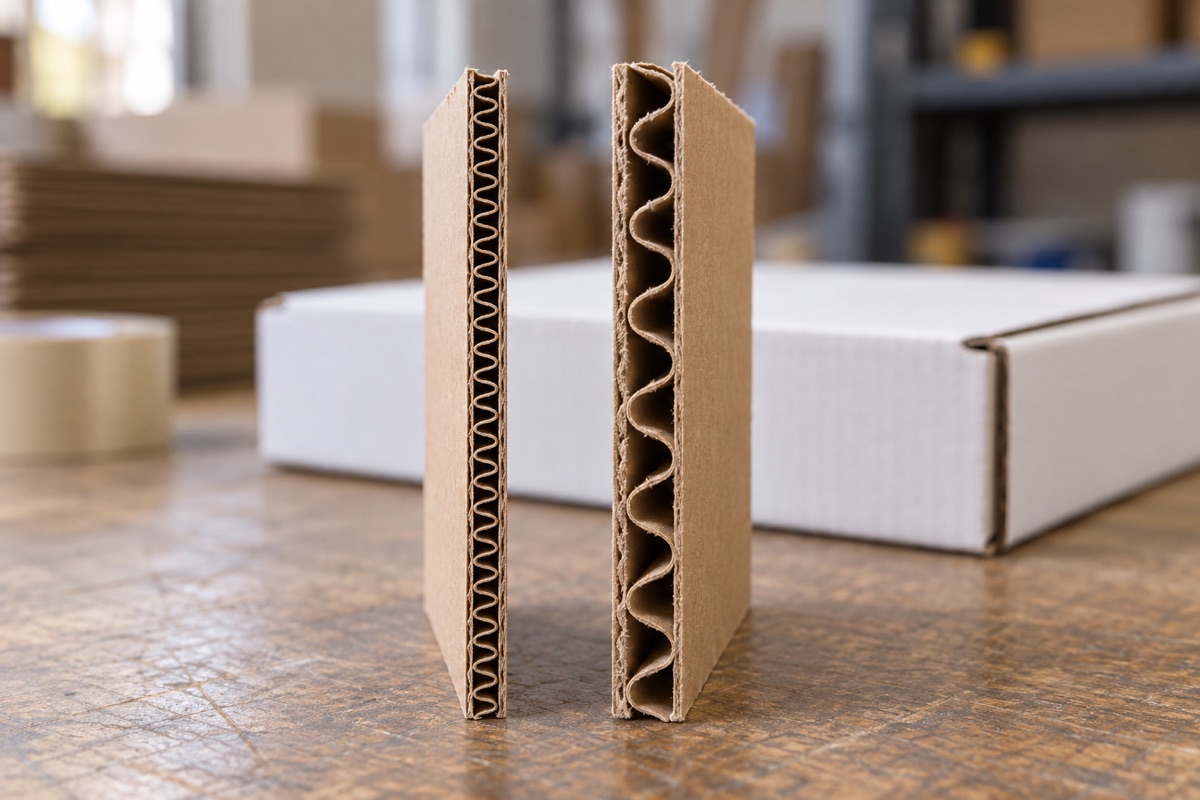
Board grade is a separate decision on top of area — how thick, how heavy, and whether a heavier grade is doing any work for your product. We covered that arithmetic separately: 1200gsm vs 1500gsm greyboard is decided by caliper and product weight, not by the number on the quotation.
3. Quantity: the steepest curve there is
Before the first box is folded, a set of one-off work exists: drawing the dieline and cutting the die, preparing print plates, cutting a foil die if the design uses foil, making masks for spot areas. That work is identical whether the run is 1,000 pieces or 50,000 — but the per-piece share of it is not. This is why the price curve falls steeply from small runs into the low thousands and then flattens, and it is the honest reason minimum order quantities exist: the setup has to be paid by the run. Across our line the minimum is 1,000 pcs per design, with unit price stepping down at 3,000, 5,000 and 10,000+.
Two practical consequences. First, the second order is cheaper than the first on the same design — dieline, die and plates exist, so only running costs remain; a supplier quoting you like a new job on a repeat is re-billing you for tooling you already funded. Second, beware the reverse trap: do not order volume you cannot use to chase the curve. Quote against your realistic annual consumption and replenishment plan, not the launch number — a price earned on quantity you never sell through is the most expensive unit price on the table.
4. Print colours: one plate and one pass each
Each colour in a design needs its own plate and its own pass through the press, so print cost grows with every colour added — a four-colour design is not "a bit more" than two colours, it is double the plate set and double the setup passes. Two buyers' decisions quietly dominate this line:
- Coverage, not edge count. A solid dark panel and fine text of the same colour are the same plate but not the same press behaviour: large solid areas lay down more ink and slow the pass. Designs with big flat colour fields cost more to print than designs that breathe.
- Spot colours vs process. A brand Pantone matched as a spot colour gets its own plate and its exact match; the same colour built from process inks rides the four-colour set and can drift between batches. Exact brand colour is a legitimate cost line — but ask for it knowingly.
Method matters at the ends of the quantity curve: short runs and multi-SKU orders often suit digital printing, longer single runs suit offset. When you request a quote, ask which your supplier would use and why — the answer is a cost decision, not a technicality, and it should match your quantity. Artwork readiness sits here too: press-ready files move straight to plates, while files needing adjustment cost time before the press ever starts — our artwork requirements page lists what "ready" means in practice.
5. Finishing: the line buyers underestimate
Surface finishing is where two quotations that looked identical on the dieline drift apart, because each finish is its own production pass: soft-touch or matte lamination is a lamination pass; foil stamping needs a foil die cut to your design plus its own pass; spot UV needs a mask made for exactly the areas that catch the varnish. None of these is a checkbox on the printing line — each is a setup with a fixed cost, and on a small run a design carrying three finishes pays three setups. That is why "add foil later" is often the cheaper sequence than designing it in from the first thousand pieces.
The question that keeps this line honest: does the quotation show each finish on its own line? If finishing appears as a lump sum, you cannot compare two suppliers at all — and you cannot tell whether you are paying for the finish or for someone's guess. Which finish to choose in the first place — foil stamping vs spot UV vs embossing, and when none of them is the right answer — is decided by your artwork and your brand, and it is compared in our finish selection guide.
6. Packing and freight: often bigger than the box price
Once the boxes exist, money moves on two more levers buyers routinely leave off the comparison. The first is packing: pieces per carton, protection between layers, and whether cartons arrive bulk or retail-ready. Retail-ready packing costs more at the factory and saves repacking labour at your distribution centre — the cheaper line is not automatically the cheaper total.
The second is cube, and it is where the biggest surprise usually lives. Freight is charged on the space a shipment occupies, and an assembled rigid box ships as a box full of air: two rigid gift boxes can occupy the carton space of ten folded ones. This is the whole argument behind flat-pack construction — explored with real numbers in rigid box vs folding carton, where a flat-pack middle option often beats both. Folding cartons ship nested flat by nature, which is why they win long replenishment runs and rigid wins the moment a customer opens the lid.
Finally, the trade term decides which of these costs sit inside the price and which land on your invoice later. We quote FOB, EXW, CFR, CIF or DDP as you require — the right choice depends on whether you have a forwarder, and a comparison across two different terms is not a comparison. Freight quoted for your actual destination and volume, not "approximate", is the only version worth holding.
7. Putting the levers to work on two quotations
When two quotations disagree, the levers tell you where to look first. Ranked by how much they typically move the gap:
- Quantity tier. Confirm both quotes price the same volume — a quote for the wrong tier cannot be compared at all.
- Board area and grade. Compare blank dimensions on the dieline, not the "size" in the email, plus gsm and caliper.
- Finishing count. Count the passes each quotation actually includes.
- Print colours and method. Same colour count, same spot or process intent, method suited to the run.
- Packing and freight basis. Same term, same destination, same volume — then compare.
Then run the two tests that settle almost every comparison: ask each supplier for the unit price at two quantities (the answer reveals the setup being amortised), and ask which lever drives the difference between their number and the cheaper one you are holding. A factory that knows its arithmetic will explain it in a sentence. And when the specification is frozen and the terms are aligned, the remaining comparison is real.
Want the Levers Quantified for Your Box?
Send your product, size and quantity. You get an itemised quotation within 24 hours with every lever on its own line — board, printing, finishing, inserts, packing and freight — plus a free dieline in 24–48 hours and a 3D mockup within 1 working day. MOQ depends on the box style; we quote on FOB, EXW, CFR, CIF or DDP terms as you require, and quotations are valid for 30 days.
Get an itemised quote →About the numbers in this guide
You will not find prices in this article, and that is deliberate: board and freight prices move with the market, which is exactly why every quotation carries a validity date instead of lasting forever. What does not go stale is the arithmetic — blank area, the quantity curve, one pass per finish. Ask any supplier to walk these levers with you; how the next quotation reads tells you whether they did.