Most cylinder packaging questions look like a shape question and turn out to be four small decisions. Get them in the right order — body, closure, liner, size — and the shape follows.
1. Types of cylinder packaging
| Type | Construction | Typical use |
|---|---|---|
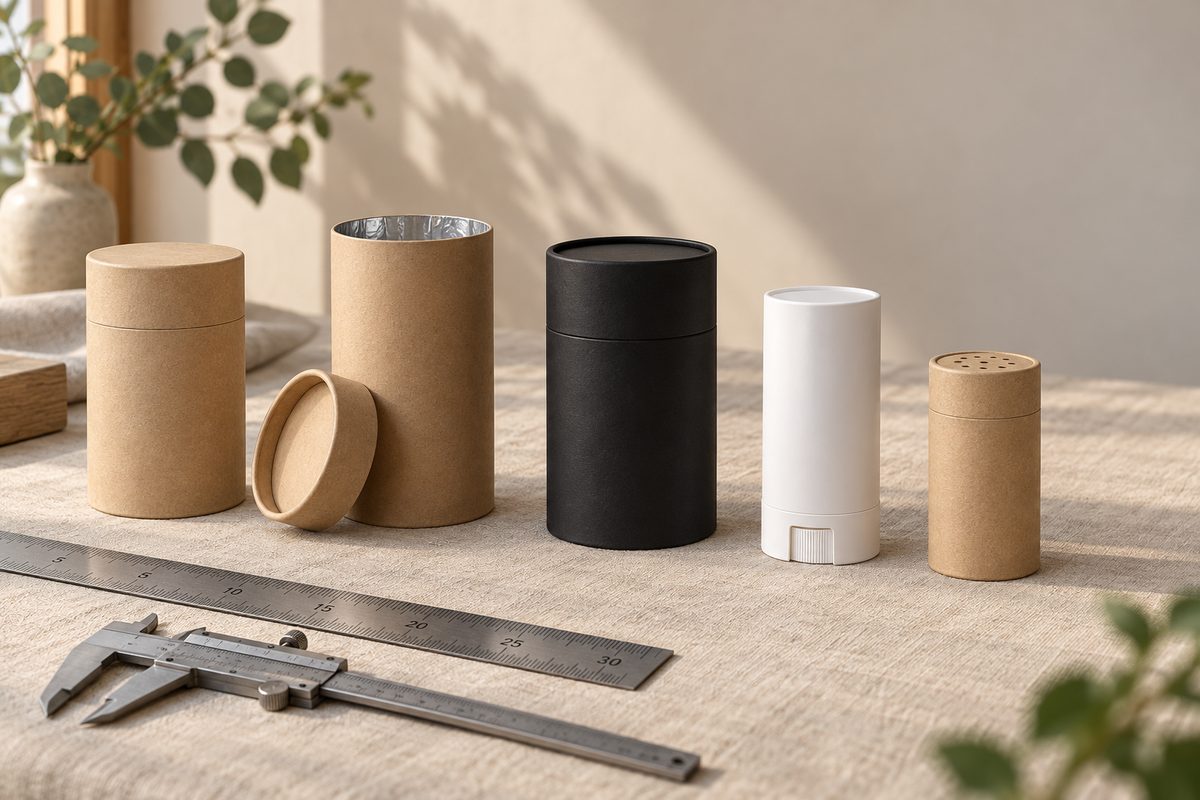
| Kraft paper tube (one-piece body) | A single wound paperboard body closed with a lid or plug | Tea, coffee, spices, dry goods, cosmetics, promotional packs |
| Two-piece telescopic cylinder | A base and a lid; the lid slides over the base | Gift sets, chocolates, personal care |
| Three-piece cylinder | Base, lid and an inner shoulder insert | Premium gifts, fragrance, luxury sets |
| Rigid cylinder box | Denser board wrapped in printed paper | Perfume, high-value gifts, retail display |
| Push-up tube | Solid base with a sliding platform inside | Deodorant sticks, lip balm, solid perfume |
How to choose: a kraft tube is the lightest and most economical shell; a rigid cylinder gives a premium feel and stronger crush resistance; a push-up tube is for products that are pushed up and used from the tube itself. Our range covers each: see the round tube with lid, the rigid cylinder gift box and the push-up stick tube.
2. Closure: how the pack opens, closes and sells
| Closure | How it works | Typical use |
|---|---|---|
| Friction-fit lid (plug cap) | Cap presses over an inner sleeve and holds by friction | Gift tubes, tea, cosmetics, general retail |
| Telescoping lid | Taller cap that slides over the outside of the tube body | Apparel, rolled goods, gift sets |
| Shaker top | Paper or aluminium top with holes for dispensing | Spices, powders, salts |
| Push-up base | Sliding platform pushes the product up | Deodorant sticks, lip balm |
| Plastic or metal end plugs | Plugs fitted into the tube ends | Poster tubes and shipping tubes |
A closure that looks fine in a render can fail in use: a friction-fit lid that is too tight scuffs the print, and one that is too loose pops open in transit. Test a sample with the real product inside before you approve the run.
3. Liner: what actually protects the product
A plain kraft tube is a good shell but a weak barrier. If the product is sensitive to moisture, grease, light or aroma loss, the liner does the protecting.
| Liner | What it protects against | Best for | Trade-off |
|---|---|---|---|
| Aluminium foil | Moisture, oxygen, light, aroma loss | Tea, ground coffee, powders, supplements | Highest barrier, but harder to recycle |
| PE coating | Basic moisture and grease | Dry goods, general retail | Balanced cost; not compostable unless specially treated |
| PLA bio-coating | Moisture, with compostable positioning | Brands that sell on compostability | Mid-range cost; test it with your product |
| Greaseproof / glassine paper | Light grease and oil | Biscuits, snacks, wrapped items | Weak against moisture and air |
| No liner (kraft only) | Nothing beyond the board | Dry, non-sensitive gifts, apparel, rolled items | Lowest cost |
How to choose: start from what the product is afraid of — moisture, grease, air, light — then pick the lightest liner that covers it. Loose-leaf tea and ground coffee lose value when aroma escapes, so foil-based liners are the common choice. A biscuit tube mainly needs grease resistance, so greaseproof paper is usually enough. For tea and coffee runs, see our tea and coffee packaging.
4. Size: how to specify the inner diameter
Give three numbers in millimetres: inner diameter × wall thickness × overall height.
- Inner diameter: measure the widest part of the product and add about 1–2 mm of clearance.
- Height: add extra length so the product does not press against the lid.
- Wall thickness: thin walls (about 0.5–1.0 mm) suit light gifts; standard walls (about 1.0–1.5 mm) suit most retail tubes; thicker walls (1.5 mm and above) suit heavier products and shipping.
- Products with a shoulder: a bottle or jar needs the inner diameter set by the shoulder, not the neck.
What can be customized
Construction, closure, liner type, diameter, height, wall thickness, outer paper and print finish can all be specified for your project. Send the widest dimension of the product and what it needs to be protected from, and we will suggest a construction. Browse the full paper tube packaging range.
FAQ
What is the difference between a one-piece and a two-piece cylinder?
A one-piece cylinder is a single body closed with a lid or plug. A two-piece telescopic cylinder has a separate base and lid, and the lid slides over the base — it opens and closes more like a gift box.
Which liner suits tea and coffee?
Aluminium foil is the common choice because it blocks moisture, light and aroma loss. PE coating is a lower-cost option for products less sensitive to aroma.
How do I choose the inner diameter?
Measure the widest part of the product and add about 1–2 mm of clearance. For bottles and jars, size from the shoulder, not the neck.
What is the MOQ and lead time?
1,000 pcs per design, with production within 15 working days after sample approval (peak season: about 1 month).
Specifying a Cylinder Pack?
Send the product’s widest dimension and what it needs to be protected from: the quotation comes back within 24 hours with the construction, closure and liner written out — plus a free dieline.
Get the cylinder pack spec →Notes on figures
Clearance and wall-thickness values are common trade ranges, not limits; the right numbers depend on the product, the board and the closure.