The question arrives with almost every corrugated enquiry: the quotation says "E-flute" on one line and "B-flute" on another, and the two boxes look identical in the photos. They are not the same board, and the difference shows up in four places you care about — how much weight the box carries, how your print looks on it, how big the box ends up, and what the freight costs. This is the specification we walk buyers through, with the numbers our own corrugated mailer line runs on.
1. What physically differs between the two boards
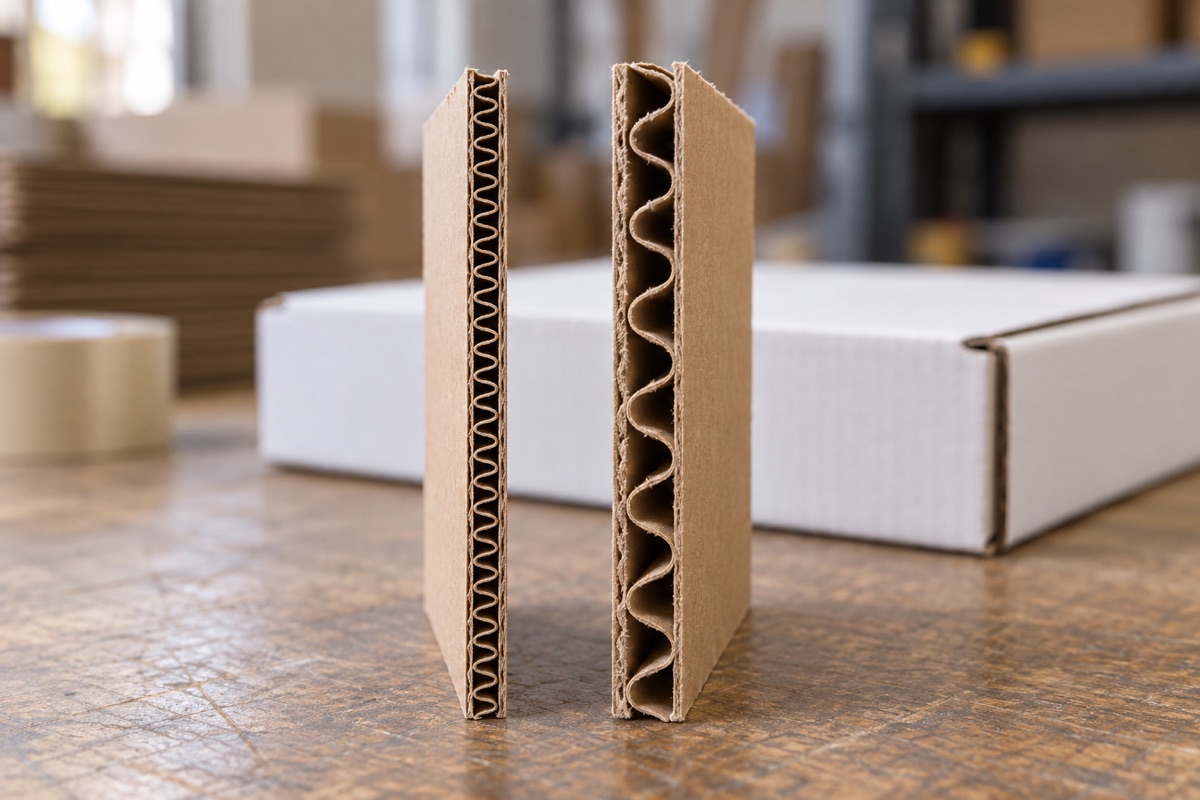
Corrugated board is a sandwich: a fluted middle sheet glued between two liners. The flute is the wave. E-flute packs about 90 flutes into a foot of board; B-flute about 49 — fewer, taller waves in the same space. That single geometric difference produces everything else.
| E-flute | B-flute | |
|---|---|---|
| Thickness (our calipers) | 1.2–1.8 mm | 2.2–3.0 mm |
| Flute pitch | ~90 flutes / ft — fine | ~49 flutes / ft — coarse |
| Surface for print | Nearly flat under a laminated liner — photographic offset | Visible flute rhythm under solid dark fills |
| Compression & stacking | Parcel-handling strength for light contents | Roughly double the wall height — the stacking choice |
| The job it does best | Printed retail mailer, unboxing, e-commerce DTC | Shipping box, heavier contents, stacked storage and export |
Neither board is "the better one" — they are tuned for different jobs. The rest of this guide is about matching the flute to your product, your print and your freight, before the specification is locked.
2. How heavy before B-flute earns its thickness?
Content weight is the first line of the specification, and the bands we quote from are simple. Up to about 2 kg of contents — skincare sets, cosmetics, small accessories, a bottle plus its insert — E-flute carries the job comfortably in single-wall. From roughly 2 kg to 8 kg — stacked knitwear, multi-piece hampers, equipment — we move to B-flute, because the failure mode that matters is no longer scuffing but corner crush and stacking. Above that, or the moment boxes go onto a pallet for export, you are looking at B-flute with heavier liners, or 5-ply double-wall BC board like our export cartons.
One correction worth making early: the flute is one layer of the protection system, not the whole of it. A glass bottle rattling loose inside B-flute arrives broken; the same bottle webbed snug by a molded pulp or cardboard insert inside E-flute arrives perfect. When a buyer shows us a dented-sample photo, the fix is usually fit and insert, not a thicker wall.
3. Which board carries your brand better?
Print is where E-flute earns its place as the DTC default. The fine flute leaves a nearly flat surface, so the board is laminated with a 250–350 gsm coated liner — the same printable paper as a folding carton — and runs through offset. Photographic full-bleed art, fine serif type, spot UV and foil all live on that liner. You can print inside the box too, which is where the unboxing moment happens.
B-flute prints two ways. Flexo with water-based inks is the volume workhorse — bold colour blocks, logos, single or two-colour branding straight onto the kraft. Laminating a printed liner onto B-flute is also possible, but the coarser flute can telegraph faint lines through solid dark fills, and the wider waves bend through a wider radius before they fold — the physics behind both effects, and the liner and creasing choices that manage them, are covered in our winter cracking guide. The honest rule: photographic art on a smooth wrap → E-flute; a bold brand block on honest kraft → B-flute flexo looks right and costs its keep. The materials themselves are compared in our paper materials guide.
4. What the extra 1.5 mm does to size and freight
Run the arithmetic on a worked example — internal 250 × 180 × 80 mm, a typical cosmetics mailer:
- Assembled size. Wall thickness enters every dimension twice. E-flute walls land the box at roughly 253 × 183 × 83 mm; B-flute at 256 × 186 × 86 mm. About 2 % more volume — rarely decisive on its own.
- Flat stock. Blanks stack at wall thickness, so a B-flute blank occupies roughly twice the height of an E-flute one in a flat-pack carton. If you warehouse boxes flat and erect them at packing, that is half the units per storage cube and per truck.
- Billed weight. The board weights per square metre are close — a few grams per blank apart, mostly from B-flute needing a slightly larger blank for the same internal size. The number to watch is dimensional weight: most parcel services bill the greater of actual and volumetric weight, and the extra millimetres can push a box across a billing bracket. Check your courier's divisor before locking the wall.
Notice what is not on this list: a big unit-price gap. Flute choice moves money mostly through freight volume and print process, not through the board name — the same five levers we break down in what drives the cost of a custom box.
5. When B-flute is simply the right call
E-flute is the visible default in DTC, which produces two common anti-patterns. The first: choosing E-flute because the sample photograph looks premium, then shipping 3 kg ceramic sets through courier sorting — the corners lose that argument. The second runs the other way: paying B-flute's freight volume for strength a silk scarf will never load. B-flute is the right specification when the contents sit above the weight band, when boxes stack in a warehouse or a container, when the parcel rides multiple legs, or when the kraft-and-one-colour look is itself the brand statement. Strength you do not load is just freight you do not need.
6. Shortcuts by product, from our own line
- Cosmetics and skincare sets → E-flute, laminated liner, offset. The unboxing standard. If the design folds heavily (crisp corners, deep tucks), F-flute’s tighter bend radius is worth knowing — see the cracking guide above.
- Apparel, knitwear, stacked tees → B-flute. Weight lives in the band where stacking strength pays.
- Electronics with glass or ceramics → B-flute with an ECT floor and an engineered insert. Name the grade — "B-flute, ECT-32 minimum" — not just the flute.
- Subscription and food → E-flute with a barrier coating. Light contents, inside-out print, moisture resistance by chemistry rather than by plastic film.
- Master and export cartons → 5-ply BC double wall. A different category from the mailer — it exists to be stacked on a pallet.
If your product sits between bands — a 2 kg hamper, a fragile 1.5 kg set — that is exactly the case to send to us: tell us the weight, the fragility and the print priority, and the flute recommendation comes back on the quotation with the board specification written out.
FAQ
Can E-flute protect a glass bottle?
Yes, within its weight band — the flute carries the box, the insert carries the bottle. A molded pulp or cardboard grid that webbs the product converts drops into deceleration the glass survives. The combination is standard on our cosmetics mailers.
Is B-flute the cheaper board?
There is no reliable unit-price rule between the two — plain flexo B-flute work and laminated E-flute work are priced by different processes. The money difference shows up in freight volume and print method, which is why we quote both when a job is genuinely borderline.
Can I combine them in one package?
Commonly done, and often the best answer: a printed E-flute mailer inside a plain B-flute shipper, or an E-flute tray sliding into a B-flute sleeve. The retail experience and the transit strength stop competing.
What about C-flute or double wall?
C-flute sits between B and the older A profile — thicker than B, common in master cartons. Double-wall BC (a B and a C flute glued together, 6.5–7 mm) is the export-stacking choice; beyond that you are specifying by ECT grade, not by flute name.
Not Sure Which Flute Your Product Needs?
Send your product weight, size and quantity: the quotation comes back within 24 hours with the flute, liners and ECT grade written out — plus a free dieline so you can check the structure before sampling.
Get the board spec →Notes on figures
Thickness ranges are the calipers of Ovanle’s own corrugated mailer line, consistent with our winter cracking guide. Flute pitches (~90 and ~49 flutes per foot) are trade-standard approximations. Weight bands are our sales specification for recommendation, not a physical limit — the ECT grade, liners and inserts carry the final judgement, and we confirm them per dieline on every quotation.