When buyers plan a custom luxury rigid box (such as our Luxury Magnetic Rigid Boxes), the board question usually arrives as "should we go 1200 gsm, 1500 gsm, or heavier so it feels expensive?" It is a fair question, and it has a checkable answer. This guide is the version we walk buyers through before they commit to a board grade.
1. What gsm tells you — and what it does not
gsm is weight per square metre, not thickness. Thickness (caliper, in mm) comes from the gsm and the mill's bulk (caliper ÷ gsm, in cm³/g). At the bulk of around 1.6 cm³/g that lightweight recycled greyboard typically has, the conversion looks like this:
| Board gsm | Typical caliper at bulk 1.6 cm³/g | Where it usually makes sense |
|---|---|---|
| 1000 gsm | 1.60 mm | Small rigid boxes, drawer bases, budget lines where every gram counts |
| 1200 gsm | 1.92 mm | Cosmetics, jewellery, electronics and most gift boxes under ~500 g of content |
| 1500 gsm | 2.40 mm | Heavy glass, spirits, large lids, deep multi-level blind debossing |
| 1800 gsm | 2.88 mm | Oversized or heavily loaded boxes; rare at consumer-gift weights |
The catch: bulk is not identical at every mill. Between roughly 1.5 and 1.7 cm³/g, the same nominal 1200 gsm can arrive anywhere between about 1.80 mm and 2.05 mm. If magnet fit, lid drop or a flush closure matters to your design — and in a rigid box it usually does — specify the gsm and a caliper window (for example "1200 gsm, 1.85–1.95 mm"), and have both checked on the golden sample. To sanity-check the conversion yourself, our paperboard thickness calculator converts between gsm, points and millimetres for greyboard, kraft and the other common box boards — the same bulk arithmetic as the table above.
2. The weight arithmetic you can check yourself
Heavier board costs you twice: once on the freight from the factory, and again on domestic courier tiers in your market, where a few dozen grams can push a parcel into the next weight band. You do not need a freight consultant to size this — it is arithmetic on the dieline.
Worked example: a 200 × 150 × 60 mm lid-and-base box uses roughly 0.10 m² of greyboard (two panels of 200 × 150 mm plus four walls of 200 × 60 and 150 × 60 mm). Moving from 1200 to 1500 gsm adds 300 g/m², so about 30 g per box — roughly 30 kg of deadweight per 1,000 boxes, before the wrapping paper is counted.
| Board | Typical caliper | Added weight per 200×150×60 mm box vs 1200 gsm |
|---|---|---|
| 1200 gsm (baseline) | 1.92 mm | — |
| 1500 gsm | 2.40 mm | ≈ +30 g |
| 1800 gsm | 2.88 mm | ≈ +61 g |
Run the same arithmetic on your own dieline and you will know whether the heavier grade is doing structural work or just costing freight. If the weight lands your parcel on a courier tier boundary, that alone can decide the question.
3. Caliper is only half the decision: moisture moves the sheet
Greyboard is paper, and paper takes moisture out of the air. Humidity hurts a box twice: it quietly strips stacking strength — the published field data, including the Fibre Box Handbook figures, is tabulated in our guide to preventing corrugated mailer cracks — and it moves the sheet itself. In an unconditioned warehouse above 80 % RH we have seen greyboard grow by around 0.2 mm, which is enough to stop a magnetic flap closing flush on a retail shelf.
Two inexpensive controls prevent almost all of it, and both belong in your specification rather than in a warranty claim afterwards:
- Say where the boxes will actually live. An unconditioned warehouse, a humid coastal market or a long sea-freight leg changes the liner, the adhesive and the magnet anchoring. When we quote a magnetic closure we ask where the goods will finally be stored — the answer decides whether a moisture-barrier inner liner goes between the greyboard and the wrap.
- Ask how the magnets are fixed. Surface-glued magnets are the failure mode: humidity and thermal cycling work the adhesive loose until the magnet pops out. The durable construction is a magnet seated in a routed board pocket and locked under the wrapped paper — ask your supplier which one you are buying, and check it on the sample by opening the box thirty times.
4. Four numbers to ask any supplier for
This is how board is checked in our own workshop before it is wrapped; ask your supplier for the same four, or check them yourself on the sample:
- Conditioning before measuring. Board is conditioned at 23 °C / 50 % RH before it is measured. A sheet measured straight off a humid delivery truck can read up to 0.2 mm thicker than the same sheet after a night in a conditioned room.
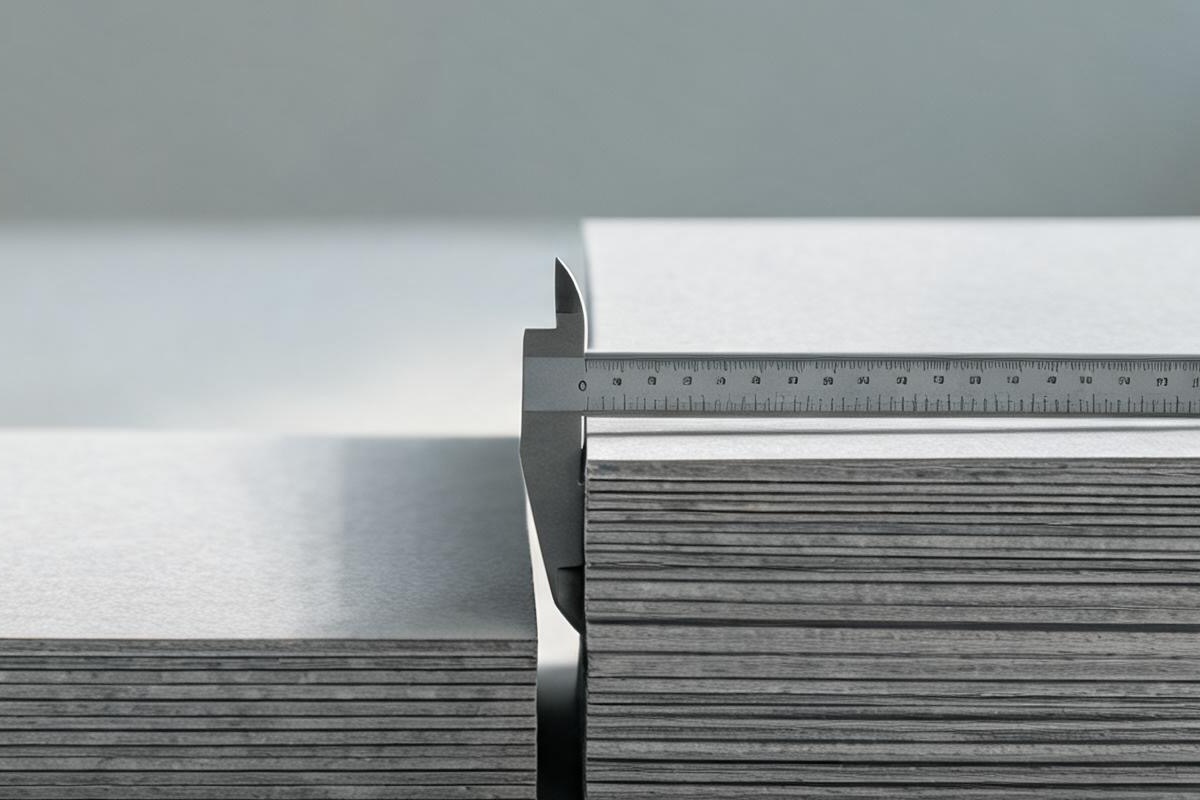
- A dead-weight micrometer, not a plastic vernier. Five points per sheet, ten sheets per batch — and the outlier is the number that should be quoted, not the average.
- The tolerance in writing. Agree a caliper tolerance in the spec — the usual industry range for rigid-box greyboard is a few hundredths of a millimetre, tighter on thinner board. Widen it and magnetic flaps start to sit proud of the wrap.
- A density check. Caliper ÷ gsm gives the mill's bulk. Typical greyboard for rigid boxes runs around 1.55–1.62 cm³/g. If a quotation works out near 1.9, the sheet sold as "1500 gsm" is a lighter board than the name suggests.
5. Four things buyers get wrong about rigid box board
"Heavier board always reads as more premium"
Past roughly 1200 gsm the difference disappears in the hand. What a customer registers is the wrap, the foil and the snap of the closure — not a third of a millimetre they cannot see.
"1200 gsm is 1200 gsm at every mill"
Bulk runs from about 1.5 to 1.7 cm³/g between mills, so the same nominal sheet can arrive between 1.80 mm and 2.05 mm. Specify gsm and a caliper window whenever a closure has to fit.
"Board thickness stops changing once it is made"
Uncoated greyboard is hygroscopic. In an unconditioned warehouse above 80 % RH, sheets can grow by around 0.2 mm — enough to stop a lid sitting flush over an embedded magnet.
"The wrapping paper is just decoration"
128 gsm wrap folds softly and forgivingly; 157 gsm holds a crisper corner but needs a tighter crease or it lifts. It is also the layer that slows moisture reaching the core, so the wrap weight belongs in the specification too.
6. What to write into the board specification
- gsm and a caliper window — for example "1200 gsm, 1.85–1.95 mm" — not just "2 mm board".
- Wrap weight and lining: 128 or 157 gsm, and whether the inside of the box is lined.
- Magnet type and fixing: surface-glued is the failure mode; mechanically anchored under the wrap is the construction to ask for.
- Storage and last-mile conditions: unconditioned warehouse, humid climate, sea freight. This decides whether you need a moisture-barrier liner.
- A signed golden sample with caliper readings, so batch two can be checked against something real instead of a memory.
Not Sure Which Board Weight to Quote?
Send us the product, its weight and the box size you have in mind. You get a board recommendation, a free dieline within 24–48 hours and a 3D mockup within 1 working day, and an itemised quotation with tooling and freight broken out.
Talk to a sales rep →Sources
Figures quoted in this article come from the published sources below. Caliper values in the tables are derived from the grammage-to-caliper conversion at the stated bulk; weight per box is arithmetic on the dieline, shown in full in the text.
- Greyboard grammage-to-caliper conversion table (lightweight recycled greyboard, bulk ≈ 1.6 cm³/g) — Paper board conversion table
- Humidity and stacking-strength field data — see the published sources in our corrugated mailer cracking guide