Both names come up in the same enquiry: a brand needs a custom printed box, has seen "rigid boxes" and "folding cartons" quoted, and the two prices are far apart. They are not quoting the same object. The difference is structural, and it reaches into your freight bill, your minimum order and what the box does at the moment a customer meets it. This is the comparison we walk buyers through, with the real specifications from our own line.
1. Two constructions, two ways of making
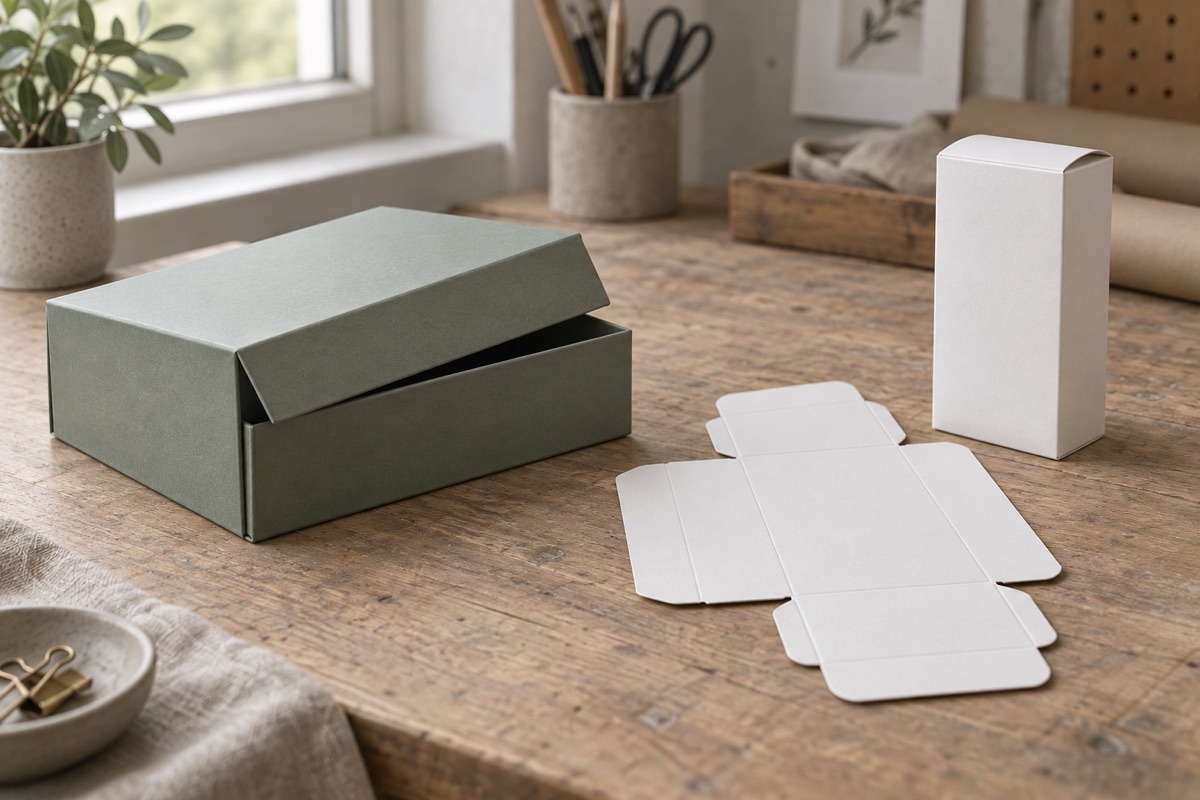
A folding carton is the board itself. One sheet — in our line 300–400 gsm SBS, ivory or folding box board — is die-cut, creased and glued on a high-speed line, then shipped flat and folded into shape at the packing bench. Our Folding Cartons & Tuck-End Paper Boxes run this construction: tuck ends, auto-lock bottoms, straight or reverse.
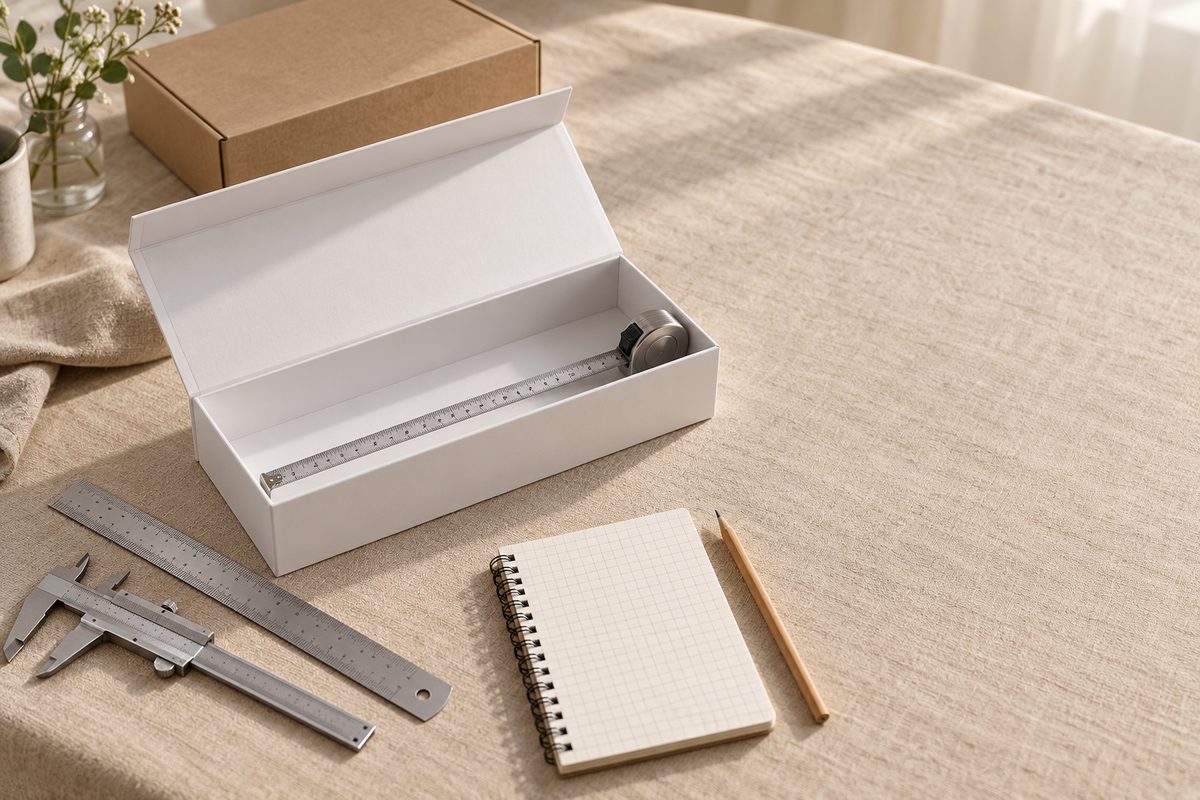
A rigid box (the trade calls it a set-up box) is two materials: a thick greyboard skeleton — 1000–1400 gsm in our Luxury Magnetic Rigid Boxes — wrapped in a printed sheet of 157 gsm art or specialty paper. It leaves the factory assembled and it can never be flattened again. The board gives the structure; the wrap carries all the print and finish.
2. The differences that decide it
| Folding carton | Rigid (set-up) box | |
|---|---|---|
| Board | 300–400 gsm SBS / FBB, single ply | 1000–1400 gsm greyboard + 157 gsm printed wrap |
| Arrives as | Flat blanks; folded at packing | Assembled; cannot collapse |
| Typical MOQ, our line | 1,000 pcs | 1,000 pcs |
| Unit cost | Lower — one material, machine gluing | Higher — two materials, wrap labour |
| Freight | Ships flat; a fraction of the volume | Full box volume on every leg |
| Shelf role | Retail replenishment, protection from dust and scuff | Gift, unboxing, keepsake, heavier contents |
| Finish ceiling | Soft-touch, foil, spot UV on the sheet | Same finishes on the wrap, plus emboss depth, liners, ribbons, inserts |
3. The freight arithmetic you can check yourself
Freight is where the two constructions quietly diverge, and it is arithmetic on the dieline — the same worked box as in our greyboard guide: 200 × 150 × 60 mm, about 0.10 m² of board per box.
- Volume. Set up, the box occupies 1.8 litres — and a rigid box occupies that space on every leg: factory to port, port to your warehouse, warehouse to customer. The same size as a folding carton ships as a flat blank; planning at roughly 10 mm stack height per carton (style-dependent), that is about 0.3 litres — six times the units per pallet centimetre.
- Weight. On the same 0.10 m²: 350 gsm carton board ≈ 35 g. A 1200 gsm rigid skeleton ≈ 120 g, plus the 157 gsm wrap ≈ 16 g. The rigid box ships roughly 4× the weight per unit — before any insert goes in.
- Afterlife. A carton flattens again at the customer's bin. A rigid box lives on — that is the point of it — but the volume it keeps occupying is exactly the volume you paid freight on.
There is a middle construction worth knowing: a flat-pack magnetic rigid box — rigid walls with creased hinges that fold semi-flat for shipping and snap set-up at packing. We build one in our magnetic line. Its trade-offs live in the hinges and the magnet anchoring, so put both on a golden sample and work the closure thirty times before you commit.
4. Where the money actually goes
Neither construction is "the cheap one" in every sense — they are priced differently. A carton's unit price is lower — one material, machine gluing — while a rigid box carries more board, a second printed sheet and wrap labour, so its unit price runs higher. On quantity there is no trap in either direction: MOQ across the line is 1,000 pcs per design — the same for both constructions, with unit price stepping down at 3,000, 5,000 and 10,000+, and no detail page hides a bigger tier behind its number.
Which produces the small surprise for new buyers: neither construction is a big-order-only product. If your first order is 1,000 units, both lines quote it as-is — and if your quantity sits below the number on the detail page, send it anyway and we will confirm what is possible rather than round you up.
5. Our verdict
- Lightweight product, sold on a shelf, reordered monthly → folding carton. Do not pay rigid freight to ship a carton's job back and forth.
- Gift, unboxing moment, keepsake, or heavy and fragile contents → rigid box. The weight in the hand is doing selling work a 350 gsm sheet cannot.
- Torn between the two → order a white mockup of each and compare landed cost per box at your destination — freight and duty inside the comparison, not just unit price.
The anti-pattern we see most: choosing rigid purely to "look premium" for a heavy product that gets reordered every month. The premium look was supposed to add margin; the freight and storage quietly take it back. Premium is a job, not a default.
6. Seven lines to settle before you order either
- Internal dimensions and product weight — the weight decides the board before the style does.
- The box's job: shelf replenishment or gift-grade presentation. Everything else follows from this line.
- Real first-order quantity and annual volume — checked against the MOQ table above, not against hope.
- Where the boxes will be stored and shipped — humidity changes liner and coating choices in both constructions (see our mailer cracking guide).
- A white mockup of each candidate construction — fold feel and closure feel are sample judgements, not catalogue judgements.
- Landed cost per box at your destination, under the trade term you will actually use.
- For rigid: magnet fixing and a caliper window on the specification — both are sample-checkable, both are where rigid boxes fail quietly.
FAQ
Can a folding carton still look premium?
For shelf work, yes: soft-touch lamination, foil and spot UV on 350–400 gsm board read as high-end. What it cannot fake is the weight, heft and permanence of a wrapped rigid wall.
What MOQ should I expect?
1,000 pcs per design for both constructions, with unit price stepping down at 3,000, 5,000 and 10,000+.
Is a rigid box always the stronger option?
Against bending and denting, yes. For stacking strength in a warehouse, corrugated board wins on compression per unit of cost. Match the construction to the failure you actually need to prevent.
Which one is the more sustainable choice?
Both are paper and curbside recyclable. On the worked example above, the carton carries roughly a quarter of the material by weight — if material footprint is your priority, the carton starts ahead.
Still Torn Between the Two?
Ask for a white mockup of each construction. Send your product, size and quantity: an itemised quotation within 24 hours, a free dieline within 24–48 hours and a 3D mockup within 1 working day. MOQ depends on the box style; we quote on FOB, EXW, CFR, CIF or DDP terms — whichever your requirement calls for.
Request both mockups →Notes on figures
Board weights and MOQ ranges are the current specifications of Ovanle's own product line (the magnetic rigid boxes and folding cartons collections linked above). Freight and weight comparisons are arithmetic on the 200 × 150 × 60 mm example, with the flat-blank height assumption stated in the text; confirm both with a quotation on your actual dieline and destination.