1. The order: L × W × H
Stand the box with its opening on top.
- Length (L): the longer side of the opening.
- Width (W): the shorter side of the opening.
- Height (H): the depth, from the bottom to the opening.
Write the three numbers in this order and keep one unit (mm or inches) for all of them. Swapping L and W changes how artwork and dielines are laid out, so the order matters even when the box looks square.
2. Inside vs outside: which one do you need?
| Inside dimensions | Outside dimensions | |
|---|---|---|
| What it is | The usable space the product sits in | The finished size of the box including its walls |
| Use it for | Product fit, inserts, how much the box holds | Fitting into a shipping carton, shelf space, storage, courier billing |
| Who works from it | Box makers specify the box from the inside | Warehouses and carriers use it |
Inside dimensions are the packaging-industry convention: corrugated box codes such as FEFCO state every size as an inside L × W × H in millimetres, and custom box makers work the same way. When you send dimensions for a custom box, send the inside size, and confirm which basis any quotation uses. We draw the dieline from inside dimensions.
3. How much bigger is the outside?
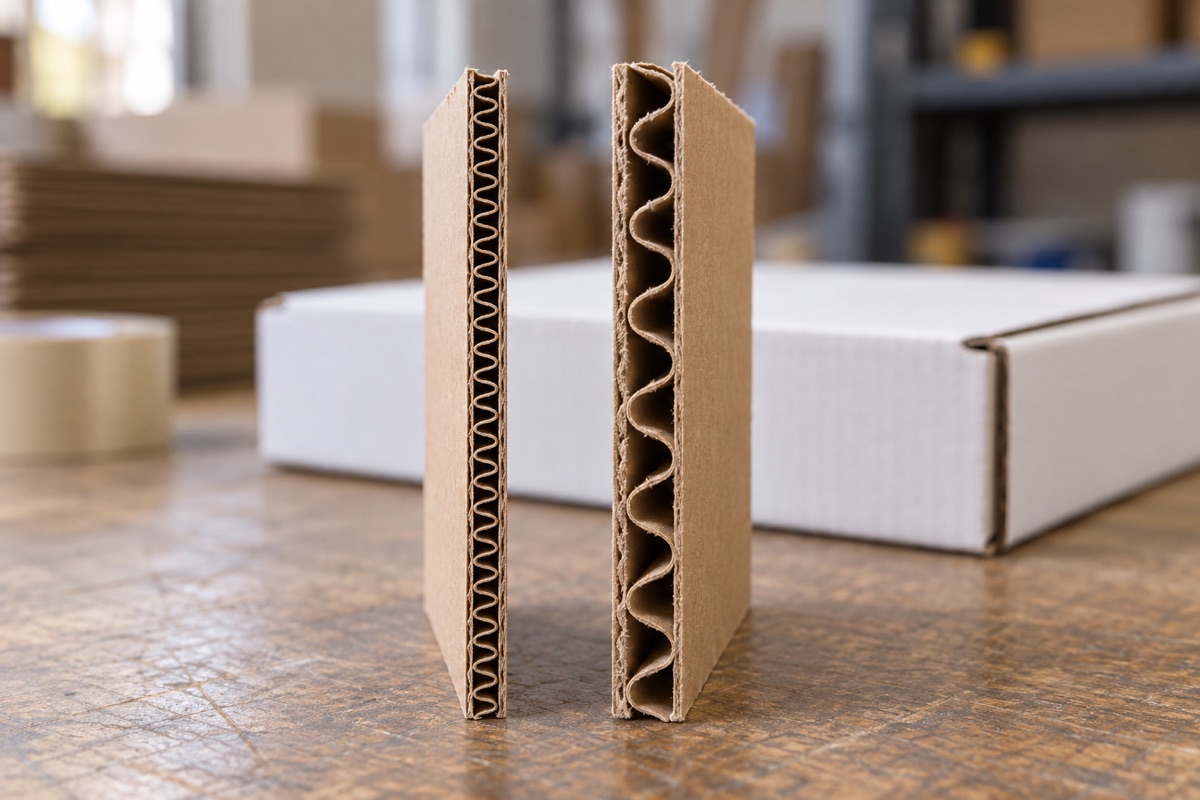
Wall thickness enters every dimension twice, once for each wall. A worked example for an inside size of 250 × 180 × 80 mm on a corrugated mailer:
| Board | Outside size (approx.) |
|---|---|
| E-flute | 253 × 183 × 83 mm |
| B-flute | 256 × 186 × 86 mm |
For rigid boxes the wall is the greyboard plus the wrap paper. A 1200 gsm board is about 1.9 mm thick and a 1500 gsm board about 2.4 mm, so the outside runs roughly 4 to 5 mm larger than the inside in each dimension, and a little more with heavier board. See E-flute vs B-flute for how flute choice changes size and freight, and 1200 gsm vs 1500 gsm greyboard for board thickness.
4. Sizing from the product
- Measure the product at its widest point in each of the three directions.
- Add clearance. For rigid and magnetic boxes, about 3 to 5 mm on each side gives a snug but easy fit. Tight-fit items such as notebooks can work with 2 to 4 mm in total, and fragile or loosely held items need more. A magnetic lid also needs a small allowance, about 2 mm, so the magnets meet and close flush.
- Add the insert. A foam collar, tray or divider takes space on every side it touches, so include its thickness before you fix the inside size.
- Check the opening. The product must pass through the opening, including any shoulder, handle or cap.
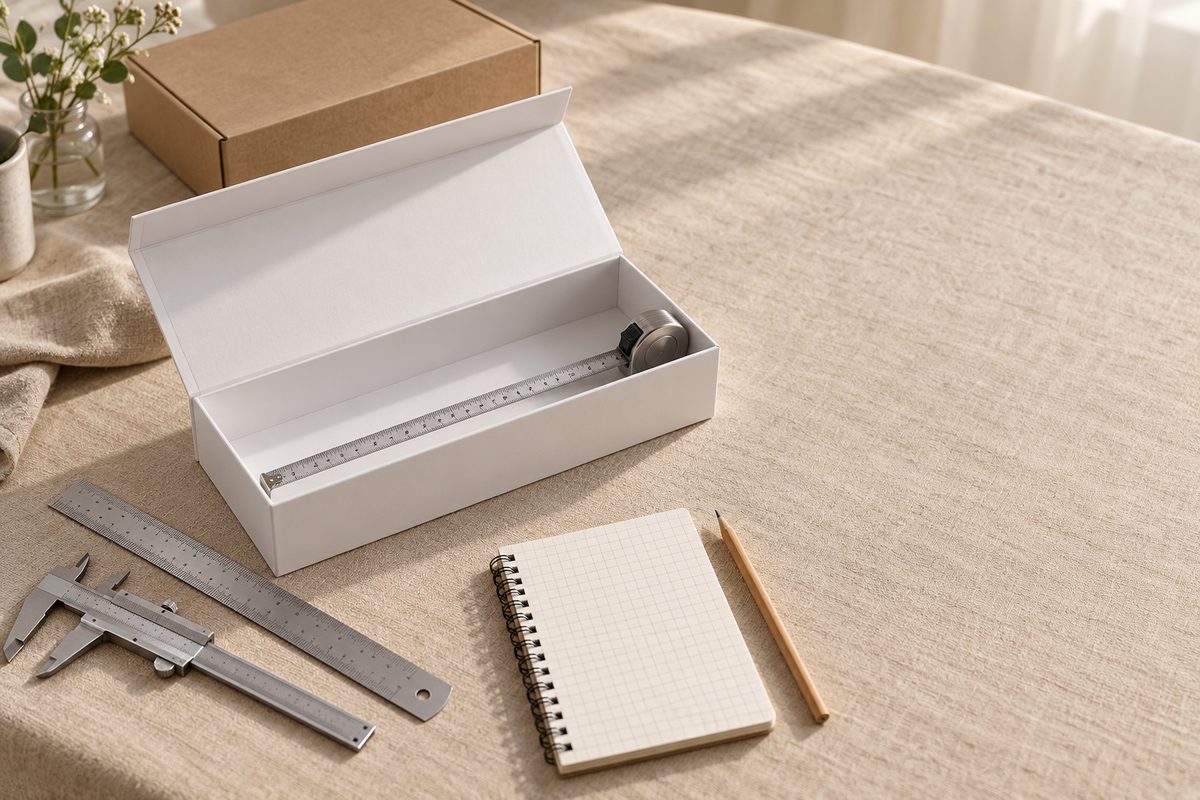
- Confirm on a white sample. A white mockup shows the fit before production, which is cheaper than finding out on the finished run. Avoid oversizing: a box that is too large lets the product move in transit.
5. Where height is measured by style
For most styles, measure with the opening facing up. Two-piece and magnetic boxes have a base and a lid, so state whether the height is the base only or base plus lid. Drawer boxes have a tray and a sleeve, so state the tray’s inside size. If a style is unclear, send the product dimensions and we will specify the box from the dieline.
6. Common mistakes
| Mistake | What goes wrong |
|---|---|
| Quoting the outside size as the inside | The box is too small by twice the wall thickness |
| Forgetting the insert | The product no longer fits, or rattles |
| Measuring a squeezed product | Soft goods such as apparel measure differently packed and unpacked |
| Mixing mm and inches | A box that is wrong by a factor of 25 |
| Swapping length and width | Artwork and dieline come back rotated |
Draw it before you order
Our free dieline generator turns your dimensions into a dieline for common structures, and the free dieline templates give you ready-made files. If you want to see the box before it is made, ask for a 3D mockup.
FAQ
Are box dimensions inside or outside?
Both exist. For product fit and for specifying a custom box, use the inside. For shipping and storage, use the outside.
What order do I write box dimensions in?
Length × width × height, measured with the opening facing up.
How much bigger is the outside than the inside?
About twice the wall thickness in each direction. On a corrugated mailer that is roughly 3 mm (E-flute) or 6 mm (B-flute) per dimension; on a rigid box roughly 4 to 5 mm.
What size should the box be for my product?
Take the widest measurement in each direction, add about 3 to 5 mm of clearance per side for a rigid box, add the insert thickness, and send those as the inside size.
Not Sure of the Right Inside Size?
Send the product’s dimensions or a photo with a ruler: the quotation comes back within 24 hours with the inside size, board and clearance written out — plus a free dieline.
Get the box spec →Notes on figures
Clearance and outside-size figures are common trade ranges, not limits; the right numbers depend on the product, the board, the insert and the closure.