Every year from November to February, brands selling into North America and Northern Europe get the same complaint: custom-printed Corrugated Mailer Boxes arriving with white cracked scorelines along the main fold. The boxes left the factory looking right. What changed was the air they travelled through.
1. Why the crease cracks in winter
Paperboard is hygroscopic — it trades moisture with the air around it until it matches. In winter, heated delivery trucks and cold dry air draw that moisture out. A drier liner has less give, so when the fold is closed the outer fibres stretch past their limit and snap instead of bending: the white line your customer sees is broken fibre, not a printing defect.
That is why "send better board" rarely fixes it. The same board that cracks in February folds cleanly in June off the same pallet. The two things that actually decide the outcome are how much moisture the board keeps and how the crease is formed.
2. What the ECT grade on your spec sheet means
ECT stands for Edge Crush Test: the edgewise compression a board takes before it collapses, quoted in pounds per linear inch. ECT-32 means the sample held 32 lb per inch of width before crushing. It predicts how a stack of mailers behaves in a warehouse, which is why spec sheets lead with it.
- Test conditions travel with the number. ECT figures are only meaningful with their conditioning: 23 °C / 50 % RH, per TAPPI T-811 or ISO 13821. A board that tested ECT-44 in the lab can read far lower after a month in a dry warehouse.
- ECT is not a cracking metric. High ECT with a brittle liner and a badly placed crease still cracks. That is why this guide is about creasing and moisture rather than buying a stronger board.
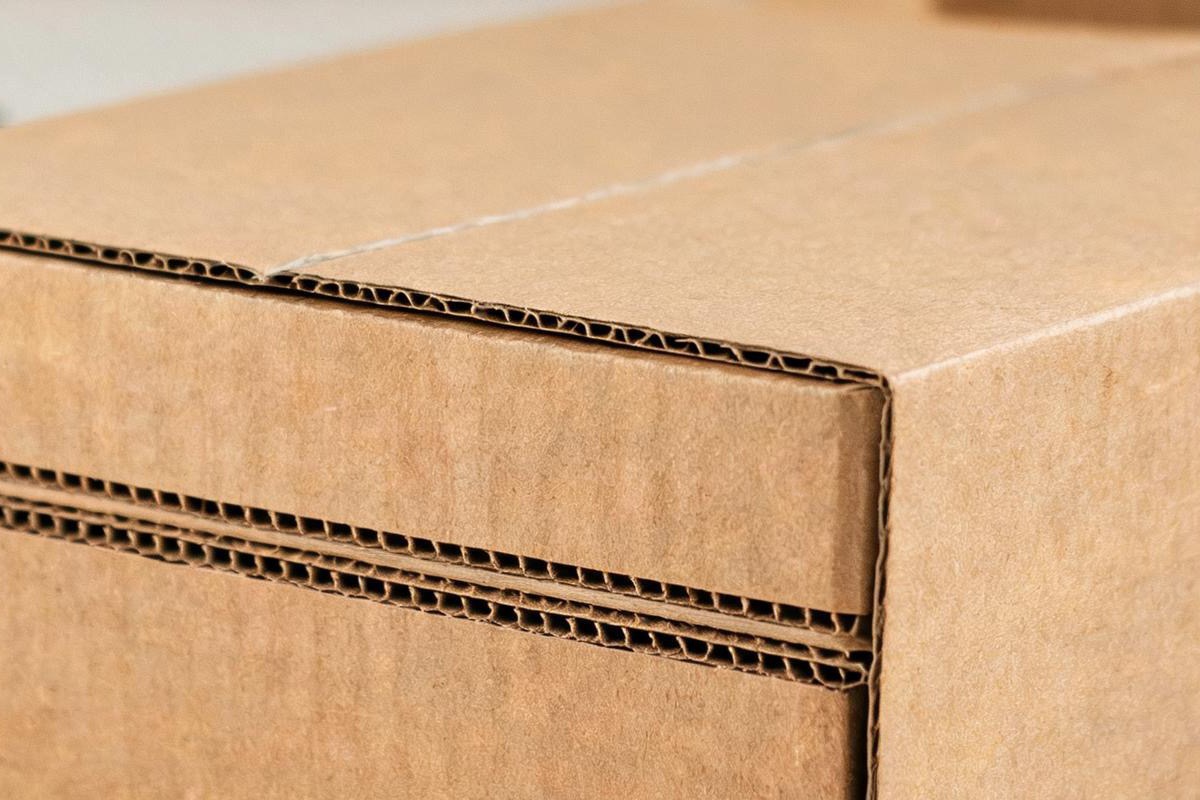
- F-flute is not "weaker". It carries a lower ECT, but its tight bend radius is exactly what makes it the safest flute for a mailer that has to fold before it has to stack.
| Flute | Height | Bend radius | Winter cracking risk on the fold |
|---|---|---|---|
| F-flute | 0.75–0.9 mm | Tight | Lowest — the usual choice for cosmetic and gift mailers |
| E-flute | 1.2–1.8 mm | Tight–medium | Low, with a good crease and a sound outer liner |
| B-flute | 2.2–3.0 mm | Wide | Highest of the three — the liner stretches further before it folds; best saved for stacking strength |
If you are choosing between the flutes in the first place — which board fits which product weight, print and freight — that decision is covered separately in E-Flute vs B-Flute: Which Corrugated Board Fits Your Mailer?
3. The three choices that actually matter
Liner fibre. Short recycled fibres crack sooner than long virgin fibres at the same moisture. You do not have to switch the whole board: a virgin or virgin-blend liner on the outside of the crease buys most of the benefit for a fraction of the cost of changing the construction.
Crease forming. Rotary creasing with the die radii quoted on the drawing beats a sharp flat-bed score for a fold that has to survive a courier. Ask your supplier to put the radii on the dieline — if they cannot, that is the answer.
Coating. A rigid film lamination cracks away from a folding board. A water-based acrylic dispersion barrier coating stays plastic-free and repulpable, and it flexes with the board instead of splitting off it. Ask for the coating by chemistry, plus a repulpability statement — not just the word "eco".
4. A correction worth knowing: "compostable film" and cold weather
Eco-minded brands often ask for zero-plastic cornstarch or PLA lamination. The pitch usually includes a claim about PLA's "glass transition point" surviving winter. The claim gets the physics backwards, and it is worth understanding why: PLA's glass transition is roughly 55–65 °C — far above any delivery van. That is precisely the problem. PLA is already in its glassy, brittle state at room temperature, and its impact toughness falls further as it gets colder. It does not need to cross a threshold at freezing; it starts out brittle.
So if a supplier sells you a compostable film on the strength of a "transition point", ask for a low-temperature fold test instead. A common version of the test: fold a scored sample through 180° after 24 hours at −10 °C and look for whitening along the crease. We can run it on request for your order. It costs one day and it finds the problem before your customers do.
5. What the published field data shows
If you need to argue a packaging decision internally, these are the numbers worth quoting — all published, all attributable:
| Condition | Measured effect | Source |
|---|---|---|
| Corrugated held above 95 % RH | stacking strength falls more than 60 % | Fibre Box Handbook (Fibre Box Association), cited by NMFTA |
| Board stored in high humidity | 30–50 % of BCT lost | Industry BCT guidance |
| Pallet overhang in transit | up to 40 % of effective BCT lost | Packaging Technology & Science (Wiley, 2023) |
| Interlocked (brick) stacking instead of column | up to 50 % of stack strength lost | Cal Poly packaging research |
| Any contact with liquid water | more than 90 % lost | NMFTA |
| Corners of a box | carry about two-thirds of the compression load | NMFTA |
Two things follow. First, the cracked scoreline is only the visible symptom — the same moisture that embrittles the liner is quietly removing a third of the box's stacking strength before anything looks wrong. Second, a humidity figure belongs in your specification as much as a flute or an ECT grade does.
6. How to specify a crack-resistant mailer
- Name the flute and the ECT grade — "E-flute, ECT-32 minimum" — not just "corrugated".
- Demand rotary creasing, with the die radii quoted on the drawing.
- Put a moisture figure in the spec: packed at 7–8 % moisture content, and ask what the supplier measures it with.
- Ask for the coating by chemistry — acrylic dispersion, wax-free — plus a repulpability statement.
- Ask for a low-temperature fold test (for example −10 °C / 180°) on a scored sample before you approve production — we can do it on request.
- Tell the supplier where the goods will finally be stored. An unconditioned warehouse or a dry-heated retail chain changes the liner and the coating choice; when we quote a mailer, it is the first question we ask.
The storage and transit lines to put in every mailer spec
- 45–50 % RH held in board storage and on the converting floor, with boxes packed within a day of creasing.
- 7–8 % packed moisture content — measured at packing, not assumed from the weather.
- Column stacking, not interlocked, and no pallet overhang: you lose up to half the stack strength for nothing.
- Wrapped against condensation for sea freight, where container walls are the usual source of liquid water.
Put those lines next to a competitor's quotation and you will see quickly whether you are comparing the same box.
Need Mailers That Survive a February Courier Van?
Send us your product, size and destination. You get a structure recommendation, a free dieline within 24–48 hours and a 3D mockup within 1 working day, a printed sample in 3–5 days, and an itemised quotation with tooling and freight broken out. MOQ from 1,000 pcs for mailer boxes.
Talk to a sales rep →Sources
Figures quoted in this article are taken from the published sources below. Where a figure comes from a supplier or trade publication we link it so you can read the original context; nothing here is our own measurement unless stated.
- Fibre Box Association, Fibre Box Handbook — stacking strength falls more than 60% above 95% RH, as cited by NMFTA — NMFTA: Packaging in the Summertime
- Kim et al., Packaging Technology & Science (Wiley, 2023) — pallet overhang reduces effective box compression strength by up to 40% — Wiley Online Library
- Singh et al., Cal Poly packaging research — interlocked stacking reduces stack strength by up to 50% versus column stacking — Cal Poly Digital Commons
- Industry box compression test guidance — board stored in high humidity loses 30–50% of its BCT value — Box Compression Test (BCT) explained
- O'Loughlin et al., Sustainability (MDPI, 2023) — PLA glass transition temperature 55–65 °C — MDPI Sustainability 15(21):15312
- Naser et al., Polymers (via PubMed Central, 2021) — Tg of PLA typically 50–80 °C — PubMed Central PMC9033233
- ECT testing standards referenced in this article — TAPPI T-811 / ISO 13821