The question usually arrives after a bad summer shipment: a pallet of candles reached a customer with fused sleeves, wax-stained board, and a cracked jar in the bottom of the box — or before a launch, when a candle brand types “heat resistant candle box” into a search engine and finds nothing that answers honestly. This is the specification we walk candle brands through, using the structures our own candle drawer box line runs on.
1. The four failures, in one table
| The failure | What actually happens | Root cause | What prevents it |
|---|---|---|---|
| Melted | Wax softens, the surface disforms, the wick leans over | Packed before the wax fully set, or a long hot leg in transit | Cure before packing; a structure that tolerates warmth instead of promising to block it |
| Stained | Wax wicks into uncoated board and leaves a permanent grease mark | Direct wax–board contact with no barrier | Barrier-coated contact surfaces; an insert that takes the contact instead of the box |
| Fused sleeve | The sleeve bonds to the jar and tears when the customer pulls it off | Warm wax + pressure + time + a tight-fitting sleeve | Clearance between sleeve and jar; textured paper that reduces contact area |
| Broken jar | Glass cracks in transit; wax and shards inside the box | A heavy jar with nothing webbing it — the board carries the drop, not the jar | A molded insert that holds the jar centred and converts drops into deceleration |
Read the table as a system, not four separate problems. Three of the four come from the same root: warm wax touching something it shouldn’t, and a jar free to move. Fix the contact and the movement, and most of the list disappears.
2. What candle packaging actually fears: wax, heat and movement
Heat sets the stage. Wax softens at temperatures that summer logistics reaches without trying: typical soy blends begin to soften from the mid-40s °C, paraffin sits higher, and a parked truck, a container on a hot quay or a non-air-conditioned warehouse can all live in that range. Nothing about that is exotic — it is a normal July afternoon in a loading bay.
Wax does the damage, and it does not need to fully melt. A softened surface is enough. Temperature swings make matters worse: a cold jar entering warm air sweats condensation, and that thin film of moisture plus a softened wax surface is what transfers onto anything touching it. This is why the failure is rarely a puddle of wax — it is a smear, a stain, a sleeve that will not let go.
Movement is the third member of the trio. A filled candle jar is heavy — a single-wick glass runs a few hundred grams, a large three-wick ceramic can pass half a kilo. Anything that heavy, loose inside a box, in a parcel that gets sorted and dropped, is a breakage looking for a corner to hit. The board around it cannot absorb that; only an insert can.
3. Each failure, and what actually stops it
Melted. The honest rule first: the candle must be fully set and cured before it is packed, and that is a process step, not a packaging feature. No box fixes a soft candle. What the structure does is tolerate the warmth it cannot prevent — a collar that holds the jar upright even if the surface softens, so a lean does not become a collapse. When we ask for your wax type before quoting, this is why: the softening range differs by blend, and the tolerance we build in follows it.
Stained. Uncoated board wicks wax like paper wicks oil — the grease travels into the fibres and the mark is permanent. The fix is a barrier on the contact surfaces, and better, an insert that takes the contact instead of the box. A stain on a replaceable foam collar is a non-event; the same wax in the tray is a written-off box.
Fused sleeve. Warm wax is an adhesive, and a sleeve that hugs the jar is a bond waiting for pressure and time. Two moves prevent it: leave measurable clearance between the sleeve and the jar, and use a textured stock — our candle sleeves run a black-core textured paper precisely because the texture reduces the contact area that can bond. The same texture reads as premium on shelf, so the engineering choice and the brand choice point the same way.
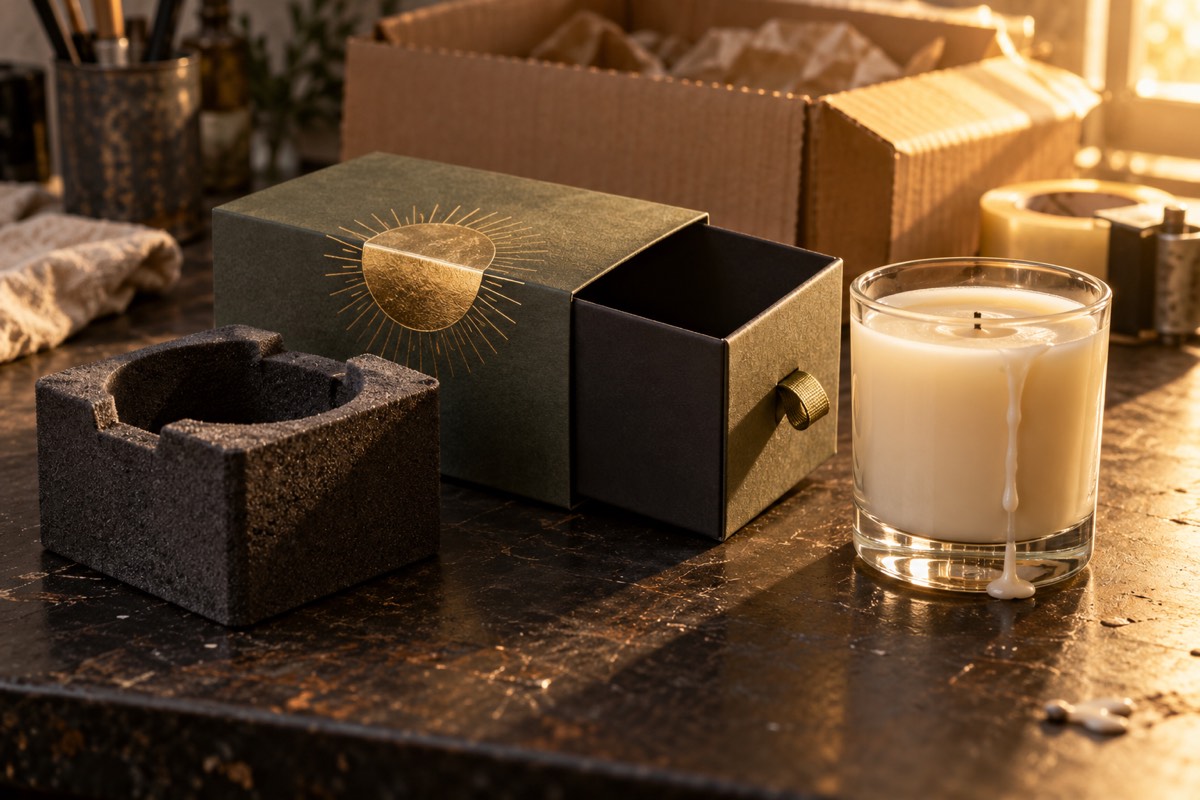
Broken jar. This is the failure the packaging industry already solved elsewhere: the insert carries the product, not the box. A molded dense-foam collar cut to the jar’s profile webs it centred in the tray, so a drop becomes a deceleration the glass survives instead of a corner impact it doesn’t. The same principle we wrote about in the flute guide — the insert carries the bottle — applies here without modification.
4. The structure that survives: our candle drawer box, taken apart
Our scented candle drawer box is the worked example — four decisions, each answering one of the failures above.
- 1400gsm heavy greyboard with reinforced perimeter walls. A heavy jar sits in that box for months — on a retail shelf, in a warehouse, in a customer’s home. Lightweight walls sag under sustained load long before they fail a drop test; the sag is what the customer sees on shelf. The reinforcement is why the box still looks square after storage.
- Custom molded dense foam collar. Cut to the jar’s profile, it centres the jar and takes the contact — the wax meets foam, not board, and the drop decelerates through the foam, not through the glass.
- Sleeve clearance plus black-core textured paper. The sleeve fits the tray, not the jar; the gap is deliberate, and the texture gives any incidental contact less surface to bond to.
- Gold foil stamped sleeve. The retail moment — the part of the structure that sells the candle before the wax does. The foil itself is a finishing pass like any other, weighed in the cost arithmetic.
Notice what is not in the list: a magic coating that makes the box heat-proof. The structure wins by keeping wax and board apart, keeping the jar still, and staying square under load — a system, not a material promise. The construction itself is rigid board, the family compared in our rigid box vs folding carton guide.
5. Shortcuts by candle type, from our own line
- Single-wick glass jar → sleeve-and-tray drawer with a foam collar. The standard shape of the category; the collar webbing the jar is what makes it shippable rather than just giftable.
- Large three-wick ceramic → reinforced walls, mandatory. Past roughly half a kilo filled, wall sag is not a maybe; the reinforcement is quoted in from the start, not added after the first complaint.
- Gift sets and multi-candle packs → multi-cavity drawer. One molded tray with a cavity per item, so nothing shifts against anything; the same collar logic at a larger footprint.
- Reed diffusers and room sprays → the same family, a different enemy. The failure mode flips from wax to oil: a leaking bottle stains everything it touches, so sealed contact surfaces and a leak-containment cavity matter more than clearance.
- Retail shelf vs direct-to-consumer shipping → different priorities. Shelf stock lives or dies by wall stiffness and look; DTC stock lives or dies by the insert and the outer shipper. Say which one your candles mostly do, and the specification tilts accordingly.
If your candle sits between these cases — an unusually heavy jar, a soft wax blend, a hot-summer market — that is exactly the case to send over. Tell us the wax type, the jar dimensions and weight, and the structure comes back on the quotation with the collar, clearance and wall spec written out.
FAQ
Is there a heat-resistant paper box for candles?
No, and you should be suspicious of any supplier who says otherwise. Paper is an insulator, not a heat shield — what survives summer transit is the system: cured wax, barrier-coated contact surfaces, sleeve clearance, and a molded insert. Anyone selling you a “heat-proof box” is selling a word, not a structure.
Can candles ship safely in summer?
Yes, with honest limits. Pack only fully cured candles, use the structure above, and choose a service that does not leave parcels baking on a hot tarmac. What we will not claim is control of the truck — the structure tolerates a hot leg; it cannot un-melt a candle that left the factory soft.
What happens if wax drips on the box anyway?
That is what the barrier and the collar are for. On a properly built box the wax meets the foam collar first, and a wipe or a replaced collar is the whole repair. On a box with direct wax-to-board contact the same drip is a permanent stain — the difference is designed in, not cleaned up afterwards.
What is the MOQ and lead time for candle boxes?
1,000 pcs per design, like the rest of our rigid line, with production within 15 working days after sample approval (peak season: about 1 month). A molded collar is cut to your jar, so sampling comes before the run.
Sending Candles Through a Hot Summer?
Send your wax type, jar dimensions and weight: the quotation comes back within 24 hours with the collar, clearance and wall specification written out — plus a free dieline and a sample before the run.
Get the candle box spec →Notes on figures
Wax softening points are typical trade ranges by wax family (soy blends lower, paraffin higher) and vary by specific blend — they are context for why summer transit matters, not a specification; we confirm the tolerance per your wax before sampling. Jar weights are typical ranges for common candle formats, not limits. The structural specifications quoted (1400gsm board, molded collar, clearance) are those of our own candle drawer box line and are confirmed per dieline on every quotation.