1. The five mailer styles
| Style | How it works | Best for |
|---|---|---|
| Roll-end tuck top | One piece; side walls roll and lock, the lid tucks into the front lip | DTC shipping, apparel, subscription boxes, branded unboxing |
| Roll-end front | A roll-end box with a shallower front lip | Folded garments, prints, documents, slim items |
| One-piece folder | One die-cut sheet wraps the product, side flaps adjust to depth | Books, media, framed prints, flat electronics |
| Tear-strip self-seal | Adhesive strip closes on press; a tear thread opens it | High-volume fulfilment, replenishment, a clean opening |
| Pizza-style flat | A shallow tray with deep walls and a hinged or separate lid | Flat items that need room: garment sets, large prints |
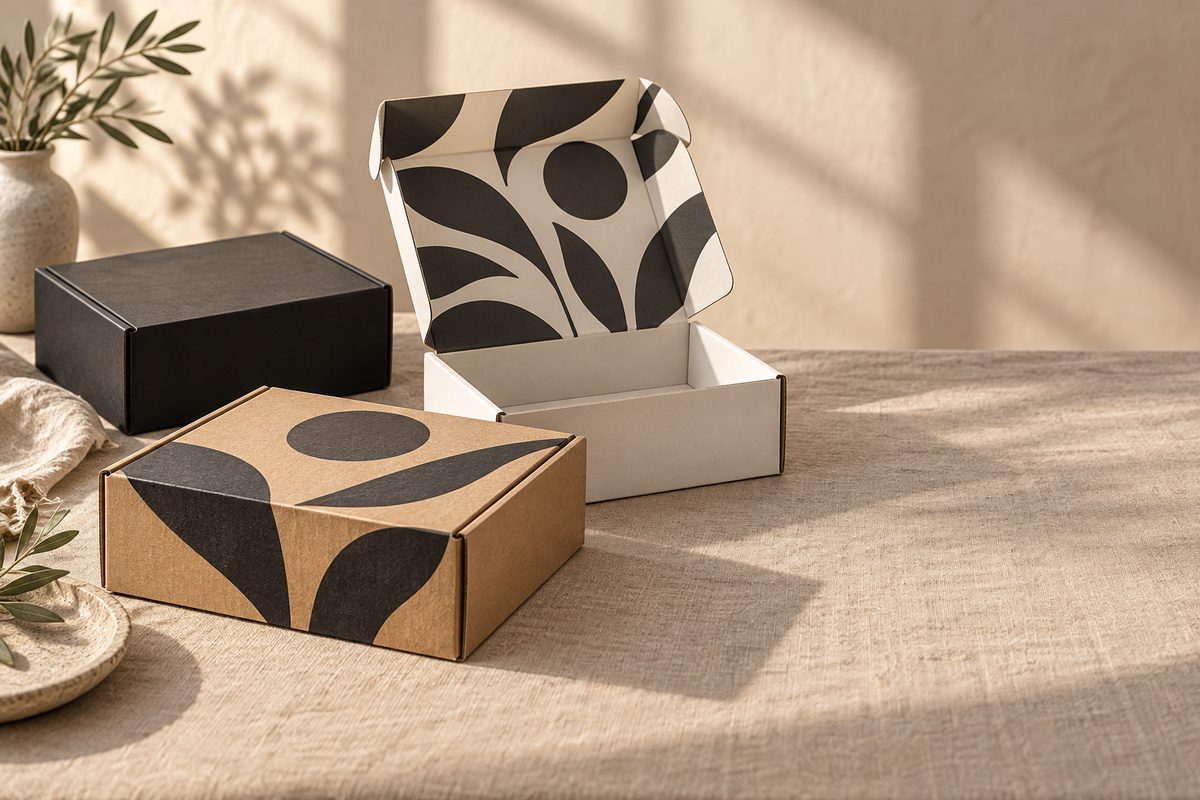
All of them ship flat and set up quickly, and all take printing on the outside and inside. Every style can be customized to your size, board, print and finish.
2. Pick the flute
E-flute is thin, so it gives a smooth face for print and a slim parcel. B-flute is thicker and cushions more, at the cost of a coarser print face and a slightly larger box. For the weight bands, print surface and freight arithmetic, read E-flute vs B-flute.
3. Pick the print method
| Direct flexo | Offset on laminated liner | |
|---|---|---|
| How it is made | Ink printed straight onto the corrugated sheet | A coated sheet is offset printed, then laminated onto the corrugated |
| Best for | Simple graphics, a bold logo or one to two colours | Photographic artwork, fine detail, premium unboxing |
| Trade-off | Fine detail and gradients are harder | Higher cost and set-up |
Minimum order is 1,000 pcs per design. Inside printing is where the unboxing moment lives, so decide early whether you want the inside printed.
4. Mailer or plain shipping carton?
A plain taped shipping carton is a generic outer box with no brand on it. A printed mailer is built to be opened by the customer: it closes without tape, takes artwork inside and out, and fits the product more closely. If the box is part of the brand experience, a printed mailer is the right tool.
5. Common mistakes
| Mistake | What goes wrong |
|---|---|
| Choosing the style before measuring the product | The wall depth and flap geometry do not fit |
| Photographic artwork on a direct-flexo run | Fine detail and gradients print soft |
| Choosing B-flute for a small, light product | A larger, heavier parcel than the product needs |
| Forgetting inside print | The unboxing moment is a plain brown inside |
| Not testing the closure on a sample | The tuck or adhesive strip fails in packing or transit |
6. Our range
Browse the corrugated mailer boxes: from a kraft e-commerce mailer and a tear-strip self-sealing box to a cosmetic subscription mailer with dividers. Not sure of the size yet? Read how to measure a box.
FAQ
What is the difference between a mailer box and a shipping box?
A mailer is a one-piece printed box that closes by tucking or by an adhesive strip and is meant to be opened by the customer. A shipping box is a plain taped outer carton for transport.
Which flute should I choose for a mailer?
E-flute for a smooth print face and a slim parcel; B-flute when you need more cushioning for heavier or more fragile items.
Can the inside be printed?
Yes. Mailers take printing on the outside and the inside.
What is the MOQ and lead time?
1,000 pcs per design, with production within 15 working days after sample approval (peak season: about 1 month).
Choosing a Mailer Style?
Send the product’s dimensions and how it ships: the quotation comes back within 24 hours with the style, flute and print written out — plus a free dieline.
Get the mailer spec →